- Recent Articles
-
Buyers Guides
- HOW TO USE COMFORT RATINGS
- BUYERS GUIDE: INSULATED WORK GLOVES
- BUYERS GUIDE: COLD WEATHER WORK BOOTS
- BUYERS GUIDE TO PAC BOOTS
- BUYERS GUIDE TO BASE LAYERS
- BUYERS GUIDE: PANTS OR BIB OVERALLS?
- BUYERS GUIDE: COVERALLS OR BIB OVERALLS?
- BUYERS GUIDE TO GLOVE DIPS & COATINGS
- LATEX vs. NITRILE COATED: WHICH IS THE RIGHT GLOVE?
- WHAT KIND OF WORK GLOVES ARE RIGHT FOR MY JOB?
- HAND PROTECTION THAT KEEPS PRODUCTIVITY HIGH
- THE IMPORTANT ROLE OF HAND PROTECTION
- HOW TOUCHSCREEN GLOVES IMPROVE SAFETY
- VITACOMFORT: A NEW LEVEL OF COMFORT & SAFETY
- WHAT TO LOOK FOR WHEN CHOOSING A WINTER WORK COAT
- WHY IS SYNTHETIC INSULATION BETTER?
- AIRBLAZE INSULATION DELIVERS MORE WARMTH WITH LESS WEIGHT
- WARMPLUS GRAPHENE LINING MAKES WARMER WORK GEAR
- DON'T COMPROMISE PROTECTION FOR PERFORMANCE
- WHY SOFTSHELL JACKETS ARE PERFECT FOR WORKING IN THE COLD
- EMBRODIERY
-
Case Studies
- CASE STUDY: INSULATED GEAR SAVES ALASKA WOMAN’S LIFE
- CASE STUDY: RACING AGAINST EXTREME WEATHER
- CASE STUDY: EXPEDITION TO ANTARCTICA
- CASE STUDY: TRANS-ALASKA PIPELINE
- CUSTOMER STORIES: TRAVIS CONSTRUCTION
- CASE STUDY: KEEPING CREWS ON THEIR FEET
- CASE STUDY: PREVENTING EMPLOYEE TURNOVER IN THE FREEZER
- CASE STUDY: REDUCE EMPLOYEE TURNOVER WITH THE RIGHT GEAR
- CASE STUDY: STAYING PROTECTED AND SAFETY COMPLIANT
-
Best Practices
- HI-VIS PPE: WHAT SAFETY MANAGERS NEED TO KNOW
- NATIONAL SAFETY MONTH: HIGH-VISIBILITY WORKWEAR THAT WORKS AS HARD AS YOUR CREW
- COLD TIPS
- NEW OSHA RULE ON PPE FOR WOMEN
- HOW TO PREVENT COLD STRESS INJURIES IN ROAD CREWS
- HOW TO STAY SAFE IN CONCRETE CONSTRUCTION
- KEY TERMS & DEFINITIONS
- HOW TO USE GLOVE LINERS
- THE IMPORTANT ROLE OF HAND PROTECTION
- PROPER FOOT CARE FOR WORKING IN THE COLD
- HOW TO PREVENT SLIPS, TRIPS & FALLS
- HOW TO CHOOSE HIGH-VISIBILITY WORKWEAR
- HOW TO LAYER WITHOUT OVERHEATING
- HOW OVERDRESSING HURTS PRODUCTIVITY
- HOW TO DRESS FOR WORKING IN THE COLD
- SAFETY TIPS FOR WORKING IN THE RAIN
- HOW TO DRESS FOR WORKING IN DIFFERENT TEMPERATURES
- HOW TO STAY SAFE & WARM WHILE WORKING OUTSIDE IN THE WINTER
- HOW TO SAFELY MANAGE & PREVENT COLD STRESS
- HOW TO STAY WARM WORKING WITH PRODUCE
- PREPARING FOR TEMPERATURE SWINGS
- THE SCIENCE OF STAYING WARM
- HOODS OR HATS: WHICH ONE IS SAFER?
- HOW DRIVERS & TRANSPORTATION WORKERS STAY DRY
- PERSONAL PROTECTIVE GEAR EVERY DRIVER NEEDS
- CHALLENGES OF WORKING IN LOW TEMPERATURES AS A DRIVER
- PROTECT YOUR TRUCK DRIVERS WITH HIGH-VISIBILITY WORKWEAR
-
Industry Knowledge
- TRADESHOWS & EVENTS
- KEY TERMS & DEFINITIONS
- HOW A HEAT-RELFECTIVE LINING IMPROVES COLD-WEATHER PPE PERFORMANCE
- BEST CLOTHING FOR MAINTENANCE STAFF IN FOOD PROCESSING
- HOW DO I STAY WARM WHILE WORKING IN MEAT PROCESSING?
- HOW TO STAY WARM IN A COLD STORAGE FREEZER
- 5 IMPORTANT PIECES OF CLOTHING FOR COLD STORAGE WORKERS
- GEAR THAT DRIVES PEAK PRODUCTION AS A FORKLIFT DRIVER
- CHALLENGES OF WORKING IN LOW-TEMPERATURE INDOOR ENVIRONMENTS
- PROTECTING PERISHABLES IN FOODSERVICE DISTRIBUTION
- TEMPERATURE CONTROL UNDER FSMA
- BEST HIGH-VISIBILITY JACKETS FOR CONSTRUCTION WORKERS
- COLD WEATHER SAFETY CHECKLIST FOR CONSTRUCTION WORKERS
- TOWER CLIMBER'S GUIDE TO WORKING OUTSIDE IN WINTER
- UTILITY WORKER'S GUIDE TO KEEPING WARM IN WINTER
- HOW TO IMPROVE DRIVER RETENTION AND RECRUITING
- THE IMPACT OF PROPER ERGONOMICS ON DRIVER WELLNESS
- QUALITY WON'T BE COMPROMISED
- WHY IRON-TUFF IS THE MOST ICONIC COLD WEATHER CLOTHING
- WHY ALL WORKERS NEED HIGH-VISIBILITY WORKWEAR
- HOW TO STAY SAFE IN LOW VISIBILITY & HIGH TRAFFIC CONDITIONS
- THE REAL COST OF HIGH EMPLOYEE TURNOVER
- HOW DOES PPE AFFECT YOUR BOTTOM LINE?
- MEDICAL COSTS OF PREVENTABLE INJURIES
- HOW TO STAY SAFE IN CONCRETE CONSTRUCTION
- HOW TO IMPROVE EMPLOYEE RETENTION IN COLD STORAGE
- HOW TO PREVENT COLD STRESS INJURIES IN ROAD CREWS
- HOW TO CHOOSE COLD WEATHER WORKWEAR FOR ROOFERS
- Use & Care
RefrigiWear Insulated Gear Helps Save an Alaska Woman’s Life
On March 21, 2026, Christy Rutter set out on what was supposed to be the first trip to her family’s newly purchased remote cabin in Alaska’s Matanuska-Susitna region. Instead, the day became a life-threatening survival ordeal that would reinforce one critical truth about working and living in extreme cold:
When conditions turn dangerous, the right insulated gear is not just about comfort. It’s about survival.
For more than 70 years, RefrigiWear has designed insulated workwear for people facing some of the harshest cold environments on earth — from industrial freezers and cold storage warehouses to oil fields, fishing docks and remote outdoor jobsites. Christy’s experience on the frozen Susitna River serves as a powerful real-world example of why selecting gear for the actual conditions — not appearance, convenience or price — matters so much.
The Situation: Alaska Cold Is Different
Christy lives in Anchorage, where outdoor recreation and self-sufficiency are part of daily life. An avid cross-country skier and hiker, she understands how quickly conditions can become dangerous in Alaska’s wilderness.
“You need to bring the right gear, because you might be there a while,” she explained after the accident. “Everything’s a risk.”
That philosophy guided her decision-making before the trip.
Christy and her husband had recently purchased a remote property accessible only by plane, boat or snow machine depending on the season. In late March, winter access meant traveling across snow trails and frozen river systems by snow machine while hauling supplies behind them.
Temperatures were below zero. Wind conditions were severe. Cell service did not exist in the area.
And despite having little experience riding snow machines, Christy knew one thing clearly: she needed gear built for the environment she was facing.
The Challenge: The Wrong Gear Can Create Dangerous Compromises
Like many consumers, Christy initially considered insulated apparel designed more for recreational aesthetics than prolonged exposure to extreme cold.
The gear looked good. It matched her helmet. It was sleek and fitted.
But there was a problem.
“It was cute,” Christy said. “But it was kind of tight.”
That detail matters more than many people realize.
In extreme cold conditions, restricted movement, compressed insulation and inadequate layering space can significantly reduce thermal protection. Tight-fitting garments reduce the insulating air space your body depends on to retain heat. Fashion-forward gear may also prioritize lightweight construction over durability, wind resistance or thermal performance.
Christy recognized those risks immediately.
“The worst thing I can do for myself is to be cold,” she said.
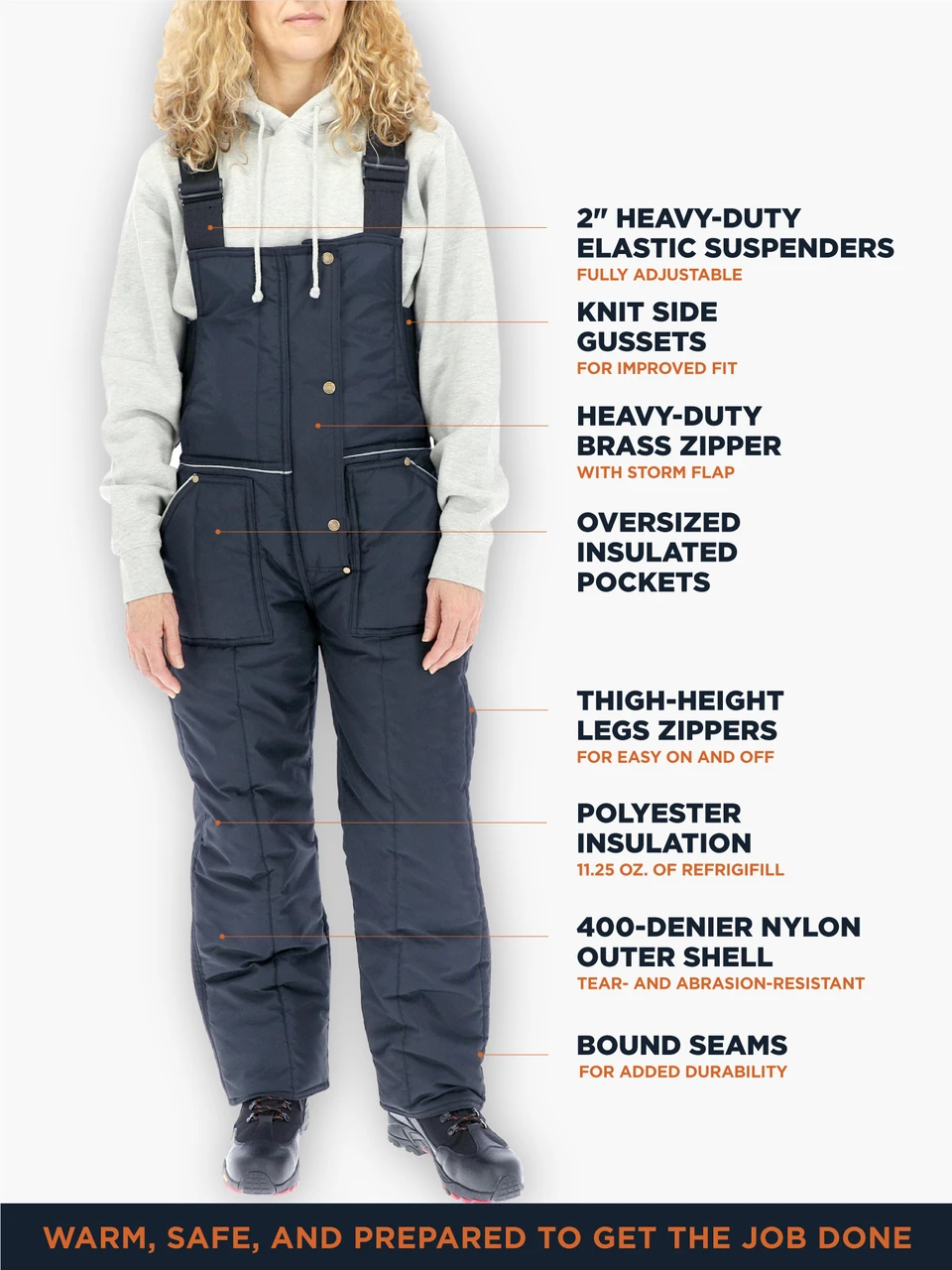
At the last minute, she took a friend’s advice to consider RefrigiWear for snow machine riding. She selected a women’s Iron-Tuff® coat and bib overalls from RefrigiWear, a collection of industry-standard PPE for workers spending long hours in industrial deep-freeze environments.
The decision likely changed the outcome of her accident.
Women's Iron-Tuff® Coat & Bib Overalls

|
|
The Accident
While traveling across the frozen Susitna River, the snow machine encountered uneven river ice and tipped onto its side.
Christy was pinned beneath the machine, suffering a catastrophic open fracture to her right leg.
Her husband managed to lift the machine enough to pull her free, but the situation remained dire. They were isolated, far from roads or emergency services and exposed to brutal weather conditions.
For the next three-and-a-half hours, Christy lay face down on the frozen river waiting for rescue.
“I could hear water underneath me,” she recalled. “The wind was blowing. It was below zero.”
Unable to move, bleeding from the fracture that had punctured her skin, and suffering severe trauma, Christy’s body entered shock. At one point, her wearable fitness tracker later showed her heart rate dropping to 44 beats per minute, with a period where no reading registered at all.
In those conditions, hypothermia could have become fatal long before rescuers arrived.
Instead, her insulated snow gear created a bubble of warmth that delivered critical protection against exposure.
Why Proper Insulation Matters in Survival Conditions
Extreme cold injuries rarely happen because a person simply “feels cold.” They happen because the body loses heat faster than it can generate it.
Once core temperature drops, cognitive function deteriorates. Decision-making slows. Blood circulation decreases. Muscles stiffen. Shock intensifies. Eventually, survival itself becomes compromised.
Christy’s Iron-Tuff® gear helped interrupt that process.
“I had that coat buttoned up to my neck and the bib overalls pulled over my boots,” she said. “There was no cold air getting in.”
That statement highlights several critical principles of cold-weather protection:
1. Wind Protection Matters
Wind strips away the insulating layer of warm air surrounding the body. In exposed environments like frozen rivers, windproof outer shells become essential for retaining body heat.
2. Coverage Prevents Heat Loss
Christy intentionally zipped her bib overalls over her boots and sealed every opening possible. Preventing gaps at the neck, wrists, ankles and waist reduces cold air infiltration dramatically.
3. Room for Layering Is Critical
Because the gear fit correctly, Christy maintained insulating air space around her body instead of compressing insulation layers.
4. Durability Becomes a Safety Feature
The Iron-Tuff® outer shell resisted tearing and abrasion during the crash and rescue process. In emergency conditions, damaged outerwear can quickly accelerate exposure risk.
Even ambulance personnel reportedly struggled to cut through her bib overalls during treatment.
Industrial Gear vs. Recreational Gear
One of the biggest misconceptions consumers make is assuming all insulated outerwear serves the same purpose.
It does not.
Gear designed for occasional recreation often prioritizes style, lightweight mobility or short-duration use. Industrial-grade insulated workwear is engineered differently because workers depend on it for extended exposure in dangerous environments.
RefrigiWear’s Iron-Tuff® Collection was originally created for workers in freezer warehouses operating in temperatures well below zero for entire shifts. That heritage influences every aspect of the product design:
- Heavy-duty wind-resistant outer shells
- High-loft insulation systems
- Extended coverage protection
- Durability under abrasive conditions
- Reinforcements at seams, hems and stress points
- Room for movement and layering
- Reliable thermal performance during prolonged exposure
Those features matter when a situation turns from inconvenient to life-threatening.
Christy’s experience demonstrates how quickly that transition can happen.
Preparation Is Part of Survival
Another important lesson from Christy’s story is that survival starts before an emergency occurs.
She and her husband carried a Garmin inReach satellite communicator because they understood the risks of remote Alaska travel. She layered carefully. She selected gear for worst-case conditions rather than expected conditions.
“I saw the minus-50 comfort rating and I thought, ‘That’s what I need. How can I go wrong?’” she said.
That mindset — preparing for the harshest possible outcome — is exactly how professionals in cold environments approach safety.
Workers in freezer facilities, commercial fishing operations, energy production, transportation, agriculture and outdoor construction all understand a simple reality: conditions can change instantly.
Equipment fails. Vehicles overturn. Storms intensify. Rescue takes time.
When that happens, the gear you are already wearing becomes your first line of defense.
The Bigger Lesson
Today, Christy faces a long recovery process that could take more than a year before she walks normally again. Yet despite the trauma, pain and uncertainty surrounding her injury, one point remains clear in her mind.
“I am forever grateful for the gear that I did choose,” she said.
Her experience is a reminder that insulated gear is not simply another purchase decision. In extreme environments, it’s the difference between danger and survival.
The right gear cannot prevent every accident.
But it can buy critical time.
It can preserve body heat.
It can reduce exposure risk.
And sometimes, it can help save a life.